Inside Chornobyl, 40 years after the disaster, the risks haven't gone away
The site of the world's worst nuclear accident is still fragile - and now caught in the middle of war
At a glance
What matters most
- A Russian drone breached Chornobyl's containment shelter in February 2025, highlighting how fragile the site still is decades after the meltdown
- Workers at the site say radiation levels remain dangerous and infrastructure is aging, making it ill-prepared for new threats
- The war in Ukraine has turned a once-isolated exclusion zone into a frontline risk zone for nuclear safety
- International experts warn that any major damage to the site could release radioactive material, though the immediate risk remains low
Across the spectrum
What people are saying
A quick look at how the same story is being framed from different angles.
On the Left
The Chornobyl site is a stark reminder of what happens when powerful institutions prioritize secrecy over safety - first under Soviet rule, and now amid a war fueled by imperial ambitions. The fact that a cheap drone could breach a nuclear containment structure shows how easily fragile gains in environmental and public safety can be undone by conflict. This underscores the need for stronger international protections for critical infrastructure and a renewed push to end the war before a preventable disaster occurs.
In the Center
While the Chornobyl reactor itself can't explode like it did in 1986, the ongoing war introduces unpredictable risks to a site that was never designed to withstand military attacks. The drone strike didn't cause a radiation leak, but it exposed real vulnerabilities. The priority now should be ensuring continuous monitoring, securing spent fuel, and keeping international experts engaged - not assigning blame, but preventing future crises.
On the Right
Chornobyl was a product of Soviet mismanagement, and today's risks are tied to a war that Ukraine continues to fight on its own soil. While the site requires protection, the broader lesson is that sovereign nations must be able to defend their territory - including sensitive infrastructure. The focus should be on strengthening Ukraine's ability to secure its borders and critical sites, rather than expanding international oversight that could undermine national control.
Full coverage
What you should know
Forty years after the Chornobyl nuclear reactor exploded in a catastrophic meltdown, the site still hums with danger. The air inside the exclusion zone feels still, but the ground beneath your feet tells a different story. Radiation lingers in the soil, in the trees, in the abandoned buildings. And now, decades after the world thought the worst was behind it, war has brought new threats to one of the most contaminated places on Earth.
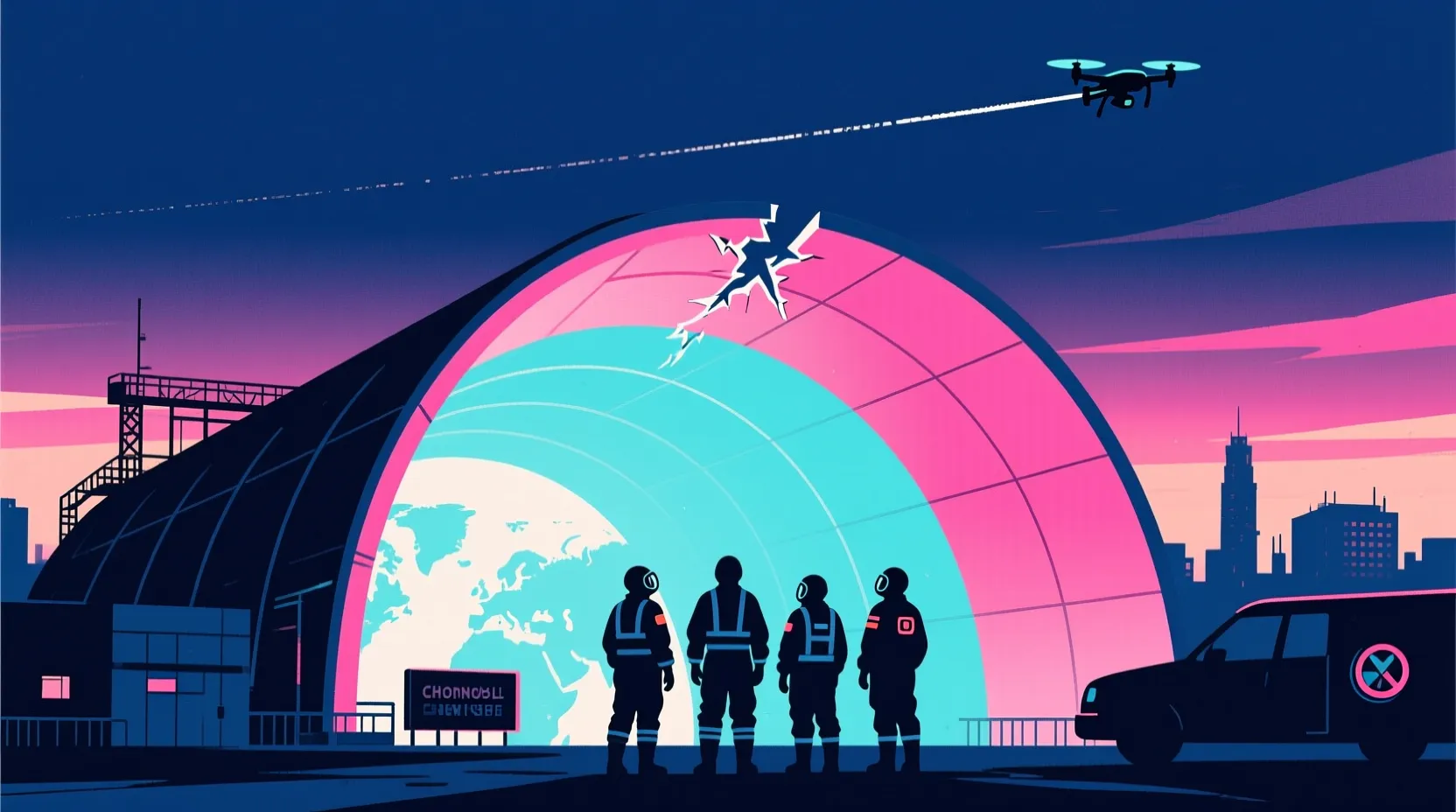
In February 2025, a low-cost Russian drone pierced the New Safe Confinement - the massive steel arch built to seal in the ruined reactor. It didn't cause a radiation leak, but it did something almost as alarming: it proved how vulnerable the structure really is. The drone tore through a maintenance hatch, leaving a jagged hole and sending shockwaves through the international nuclear community. Workers on site say they've been on edge ever since.
The original disaster in 1986 released hundreds of times more radiation than the atomic bombs dropped on Hiroshima and Nagasaki. The Soviet response was slow, secretive, and chaotic. Today, the cleanup is still ongoing. The New Safe Confinement, completed in 2016, was meant to last a century. But no one planned for war. Now, with Ukraine still defending its territory, Chornobyl sits just miles from active conflict zones.
Engineers and scientists working there describe a tense routine. Radiation monitors beep constantly. Protective gear is standard. Some areas are still too hot to enter for more than a few minutes. The biggest fear isn't a repeat of 1986 - that kind of explosion isn't possible now - but that damage to the containment structure could stir up radioactive dust or compromise spent fuel storage.
International Atomic Energy Agency (IAEA) officials have called for greater protection of nuclear sites in conflict zones, pointing to Chornobyl as a warning. While the immediate risk of a large-scale release remains low, the consequences would be severe. A major breach could contaminate water supplies, affect agriculture, and force new evacuations - not just in Ukraine, but in neighboring countries.
For locals, many of whom were evacuated as children, the anniversary is bittersweet. Some visit the edge of the zone to remember lost homes. Others worry that the world has moved on too quickly. The war has refocused attention on Chornobyl, not as a relic of the past, but as a symbol of how fragile safety can be when politics and conflict take over.
As the fourth decade closes, the site stands as both a monument and a warning. The reactor is silent, but the risks aren't gone - just changed. And as long as the war continues, Chornobyl won't just be a memory. It'll remain a place where history, radiation, and uncertainty still mix in the air.
About this author
Zwely News Staff compiles multi-source reporting into concise, viewpoint-aware coverage for readers who want context without noise.
Source Notes
Inside Chornobyl: 40 years after disaster, nuclear site still at risk in Russia’s war
In February 2025, a cheap Russian drone tore through Chornobyl’s confinement shelter. Workers warn the site of the world’s worst nuclear accident is not safe yetThe dosimeter clipped to your chest ticks faster the moment you step off the de...
Inside Chornobyl, 40 years after the world's worst nuclear disaster
Forty years ago, the world's worst nuclear power disaster exploded into history at the Soviet Union's Chornobyl nuclear plant in what is now Ukraine. The ensuing cover-up and clean-up operation made Chornobyl a byword for dereliction and mi...
Previous story
Iran's foreign minister heads to Pakistan as US envoys prepare for high-stakes talks
Next story